
Face Detection and Alignment in Automotive: Easy to Build, Hard to Ship
Published on April 08, 2021
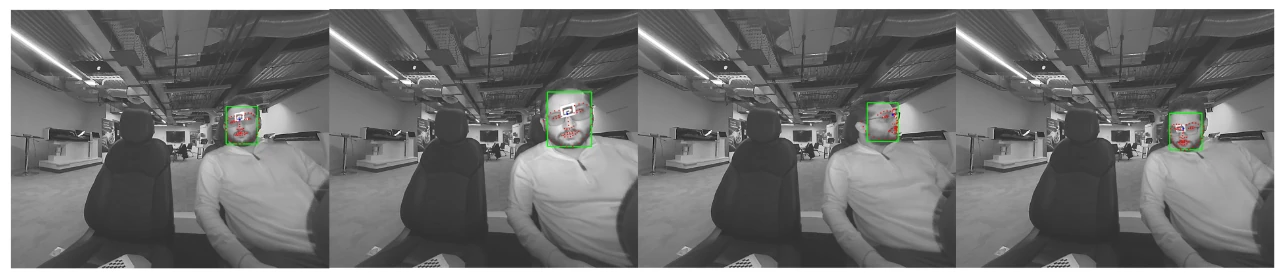
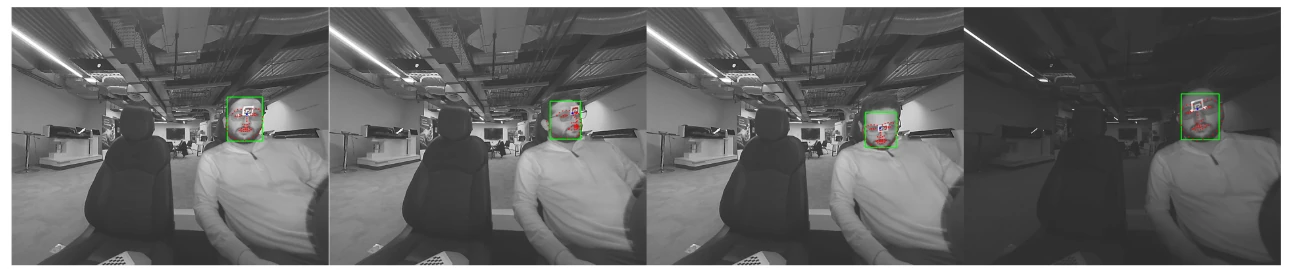
Face detection and face alignment are often presented as solved problems.
Open-source models are everywhere, demos look convincing, and a prototype can be built in a few days.
And yet…
In the automotive driver monitoring context, turning these algorithms into robust, real-time, production-ready systems is anything but trivial.
This article explains why face detection and alignment are affordable to develop, but hard to deploy at scale under real automotive constraints.
1. The Illusion of Simplicity
From a lab or demo perspective, face detection and alignment look easy:
- Plenty of open-source models
- Good performance on RGB datasets
- Fast inference on GPUs
- Clean frontal faces
You can get a working pipeline with:
- A face detector
- A landmark model
- A simple alignment transform
But automotive is not a lab.
2. The Automotive Driver Context Changes Everything
Driver Monitoring Systems (DMS) operate in one of the most constrained vision environments:
- Fixed in-cabin cameras
- No control over lighting
- Long product lifecycles (10+ years)
- Safety-critical requirements
- Strict cost and power budgets
The face you need to detect and align is:
- Partially occluded (hands, steering wheel)
- Seen from below or from the side
- Captured in near-infrared (NIR)
- Moving continuously
And it must work all the time.
3. Real-Time Constraints: Milliseconds Matter
In automotive DMS:
- Face detection + alignment must run at 30–60 FPS
- Latency budgets are often < 10–15 ms
- The pipeline runs alongside many other perception tasks
This means:
- No heavy backbones
- No multi-stage cascades without optimization
- No reliance on large GPUs
A model that works well on a desktop GPU often fails to meet:
- Deterministic latency
- Thermal limits
- Power consumption constraints
Real-time ≠ fast on average.
Real-time means fast, every frame, worst case.
4. Embedded ECUs: The Hardware Reality
Most production DMS systems run on:
- Automotive-grade SoCs
- DSPs, NPUs, or small GPUs
- Limited memory bandwidth
- Fixed-point or mixed-precision pipelines
Key challenges:
- Quantization (INT8 / FP16)
- Operator support limitations
- Memory access patterns
- Batch size = 1
Many academic or open-source models:
- Do not quantize cleanly
- Break under reduced precision
- Rely on unsupported layers
Getting face detection and alignment to run reliably on an embedded ECU often requires significant redesign, not just optimization.
5. Near-Infrared (NIR): A Different Visual World
Most face models are trained on RGB images.
In automotive cabins, especially at night:
- Cameras operate in NIR
- Faces have different contrast and texture
- Skin appearance changes
- Glasses reflect IR light
- Eye regions saturate
Consequences:
- RGB-trained models generalize poorly
- Landmarks drift or collapse
- Detectors fail under certain illuminations
NIR requires:
- Dedicated datasets
- Sensor-specific preprocessing
- Careful augmentation strategies
This alone can double the effort.
6. Large Head Rotations: The Silent Killer
In real driving:
- Drivers look at mirrors
- Check blind spots
- Look down or sideways
- Rotate their head beyond 60–90°
Most face detectors and aligners are optimized for:
- Frontal or near-frontal faces
- Mild yaw and pitch
In DMS:
- Profile faces are common
- Partial faces must still be detected
- Landmarks disappear or self-occlude
Handling large pose variations requires:
- Multi-view training
- Pose-aware detection
- Landmark models that degrade gracefully
- Often, tighter coupling with head-pose estimation
This is rarely “plug and play”.
7. Robustness Over Accuracy
In consumer demos, accuracy is king.
In automotive:
- Stability > peak accuracy
- No flickering detections
- No sudden landmark jumps
- Predictable failure modes
A detector that is:
- Slightly less accurate
- But stable across time, lighting, and poses
…is far more valuable than a high-scoring benchmark model.
Temporal consistency becomes as important as spatial accuracy.
8. Why Development Is Affordable, But Production Is Not
Affordable:
- Prototyping
- Benchmarking
- Demo-level performance
- GPU-based experiments
Expensive:
- Data collection in NIR
- Embedded optimization
- ECU-specific deployment
- Validation across edge cases
- Long-term robustness testing
The real cost is not in writing the model —
it’s in making it never fail in the car.
9. Final Thoughts
Face detection and alignment are often underestimated in automotive systems.
Yes, you can build them quickly.
But making them:
- Real-time
- Embedded-friendly
- NIR-robust
- Pose-invariant
- Stable over time
…is a serious engineering challenge.
In Driver Monitoring Systems, face detection and alignment are not just preprocessing steps —
they are safety-critical perception components.
And that changes everything.